
AI Fatigue Has Arrived. Better Messaging Is Becoming a Market Advantage.

Key Takeaways:
AI fatigue is real, and it is changing how audiences respond to marketing, messaging, and brands.
The threat is not AI itself. It is sameness, inflated positioning, and content that feels generic.
The opportunity is to use AI as a foundation while letting expertise, judgment, and point of view lead.
Brands that stand out now will be the ones that sound informed, specific, and human.
AI now shows up in nearly every product pitch, category page, sales deck, and content plan. Open a handful of B2B homepages and most — if not all — will claim to be AI-powered, intelligent, personalized, automated, or optimized.
Marketers are running into a problem nobody could have avoided forever. AI moved from differentiator to default language at a pace few categories have seen before. Product pages changed. Decks changed. LinkedIn posts changed. Webinar titles changed. Suddenly every company sounded fast, smart, and future-ready in exactly the same way.
Buyers noticed.
Plenty of them still want the capability. Plenty still believe AI can improve workflows, shorten grunt work, surface better signals, and help teams move faster. Skepticism is aimed somewhere else: at the lazy wrapper around the promise. A headline that says AI-powered without explaining what changed. A landing page that says personalization without naming what gets personalized. A sales deck that says efficiency without telling anyone where time, money, or friction actually comes out of the process.
Fatigue grows in that gap.
For brands, the challenge is no longer whether to talk about AI. The challenge is whether the story underneath the label is strong enough to survive contact with a serious buyer.
“AI-Powered” Has Lost Its Edge
A year or two ago, adding AI to the lead message could buy curiosity on its own.
For early adopters, the label signaled momentum. For cautious buyers, the label signaled relevance. For crowded SaaS brands, the label often created enough intrigue to earn the next click, the next slide, or the next meeting.
We have seen the market change up close. When we first brought out our AI-assisted editorial service, the concept generated immediate interest. It opened doors, sped up conversations, and gave the offer a built-in sense of novelty. That is just no longer enough.
Buyers still want to understand where AI plays a role, but the label alone does far less work than it used to. Curiosity now comes from the explanation: how the system helps, what improves because of it, and where human expertise still makes the difference.
Once every company starts reaching for the same language, novelty wears off and shortcuts lose value. A phrase that used to sound sharp starts sounding borrowed. A claim that once felt bold starts sounding unfinished. Buyers stop rewarding the mention of AI and start pressing for the missing details.
We see the same pattern in messaging reviews all the time. Teams name AI early because they assume the term itself carries meaning. Meanwhile, the parts buyers actually care about arrive late or not at all.
A homepage promises “AI-powered insights,” but never explains what data shapes those insights.
A platform claims “smarter personalization,” but never clarifies whether the system personalizes content, routing, offer timing, outreach, or follow-up.
A service firm talks about “AI-enhanced content,” but never explains where automation helps and where experienced strategists and editors still make the real calls.
Capability may be real in every one of those cases. Copy still falls flat because the explanation never catches up to the claim.
Audiences No Longer Respond to the Same AI Language
Overexposure is one reason.
Vocabulary pileups happen in every crowded category. A handful of useful words get copied across websites, campaigns, decks, and category pages until none of them help a buyer tell one company from another. AI language has landed there fast. Smarter, faster, personalized, and efficient now show up so often that they read more like category filler than brand signal.
Content volume is another reason.
AI has made it dramatically easier to produce blog posts, nurture emails, webinar abstracts, ad variants, short-form videos, landing pages, and sales support content at scale. Output has gone up. Distinctiveness has not kept pace.
Readers feel the difference immediately. A piece can be grammatically clean, structurally competent, and strategically empty all at once. Plenty of AI-era content sounds fine on first pass and forgettable on second. Smooth writing is not the same thing as informed writing.
B2B buyers are especially quick to catch weak positioning because the buying environment is less forgiving. A procurement-heavy committee wants more than a promising phrase. A VP of Marketing evaluating vendors wants to know what changes in the workflow. A product marketer trying to refresh a tired category story wants wording that can survive scrutiny from sales, leadership, and customers alike.
Broad AI claims struggle in those rooms because broad claims leave too much work for the audience.
The Real Cost of Sounding Like Everyone Else
Plenty of teams still treat AI fatigue like a style problem. A few copy edits won’t solve it.
Commercial risk shows up first in differentiation. Five companies in the same category can all claim better automation, stronger personalization, and more intelligent decision-making. Buyers leave with a stack of modern-sounding messages and very little separation between them.
Trust usually weakens next.
Generic AI language now triggers a quiet internal question in the reader’s mind: What is actually behind that line? Once skepticism enters at that point, every other sentence has to work harder. Marketing inherits the burden. Sales inherits the burden. Customer success sometimes inherits it later when the original promise was phrased too loosely to hold up in practice.
Long sales cycles make the problem impossible to hide. More stakeholders join. Questions get sharper. Buyers ask what the system really does, what data it uses, what outputs improve, what limitations still exist, and where human judgment remains essential. Messaging built on AI shorthand starts cracking under ordinary due diligence.
Content reveals the same problem in public view. A blog post can hit the right topic, use the right keywords, and still sound like nobody in particular wrote it. Readers rarely remember those pieces. Buyers rarely trust them. Competitors can usually publish near-identical versions by Friday.
Brands lose more than style when that happens. Brands lose memorability, trust, and the chance to sound like the people behind the work actually know the work.
Weak Framing Undermines Everything That Follows
Saturation creates a useful kind of pressure.
When lazy language floods a market, disciplined language gets easier to notice. Buyers are tired of being 'personalized' by an algorithm that doesn't understand them. They are looking for content that proves a brand understands the mechanics of their business, not just their name in an email subject line.
Look at the difference.
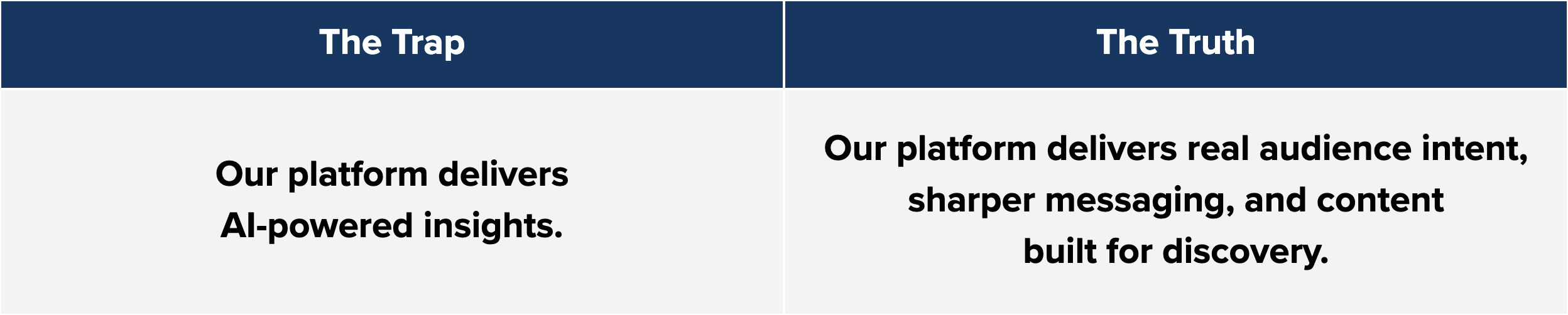
One version asks the buyer to imagine the value. The other gives the buyer something concrete to assess.
Service businesses face the same test. “We use AI to make content more efficient” says almost nothing. “We use AI to speed first-pass synthesis, repurposing, and workflow support while strategists and editors shape argument, audience fit, and final quality” gives a prospect a much clearer picture of how the work actually gets done.
A sharper market usually rewards sharper explanation. That is good news for companies with real substance behind the scenes.
Proof also starts carrying more weight than posture once a category matures. Buyers want the mechanism, the role of human oversight, the operational gain, and the limit. A bold headline can still open the door. Evidence decides whether anyone stays in the room.
Real Expertise Is Getting Easier to Recognize
Crowded markets make real expertise more visible.
Readers do not always describe the difference elegantly, but they feel it fast. Writing shaped by experience tends to make cleaner choices. Strong operators know which claim deserves evidence, which promise needs restraint, which example will actually land with the audience, and which detail sounds impressive internally but meaningless to a buyer.
We see one version of that in positioning decks. The AI slide is often the least specific one. The stronger story usually appears later, right where the team starts talking plainly about customer friction, workflow breakdowns, service model, or buying obstacles. Operational knowledge produces better copy than trend alignment ever will.
B2B raises the stakes here. Buyers are not merely comparing features. Buyers are trying to reduce uncertainty. They want signs that a company understands the category, the likely objections, the hidden tradeoffs, and the context in which the product or service has to perform.
AI can absolutely help with research, synthesis, repurposing, and speed. Judgment still decides what deserves emphasis, what deserves caution, and what the audience will believe.
Plenty of brands are now publishing content that sounds assembled instead of observed. Expert-led writing stands out faster in that environment because it brings sharper nouns, cleaner examples, and better filters to the page.
Fix the Message Before the Market Moves On
A cleaner AI story usually starts with one uncomfortable question: does AI belong in the lead at all?
Some companies should lead with it. A product built around model performance, workflow automation, prediction, or AI-native functionality would be foolish to bury the role AI plays. Other companies reach for the label far too early. Service firms, consultancies, agencies, and many B2B brands often get more mileage by leading with the business outcome, market insight, editorial process, or customer problem first, then explaining where AI supports the work.
From there, replace category shorthand with operational language.
Name the task. Name the input when useful. Name the output when useful. Explain where time comes out, where quality improves, or where decision-making gets stronger. Serious buyers do not need a technical white paper in the middle of a homepage. Serious buyers do need enough specificity to understand the claim without guessing.
A simple audit can help:
Can a buyer tell what changed?
“AI-powered” is not an explanation. Spell out the workflow change in plain language.Can sales defend the claim in one minute?
Marketing language should survive a follow-up question without collapsing into buzzwords.Can a competitor swap its logo into your copy?
Interchangeable language signals unfinished positioning.Can your team explain where human judgment still matters?
Overselling automation creates trust problems later.Can you point to proof?
Proof may come from process, data, outcomes, constraints, or governance. Copy gets stronger the moment a claim has something underneath it.
One of the biggest breakdowns in content development happens when subject-matter experts are brought in only after the core message has already been framed. By that point, the work is often being refined rather than strengthened. The best content is shaped earlier, with strategy, category expertise, and editorial judgment influencing the direction before the draft settles into familiar, low-risk language.
The same logic applies to publishing volume. More content can create more visibility, but authority is not built through frequency alone. It is built through content that demonstrates real understanding, offers a clear point of view, and earns trust over time.
Where the Market Goes From Here
AI fatigue is not a passing mood. Oversupplied language created it. Better language will decide who moves through it.
The first phase of AI marketing rewarded visibility. A company could sound current simply by associating itself with the technology. The next phase is harder and healthier. Buyers now reward explanation, proof, and control.
Brands that keep leaning on broad AI wording will sound more interchangeable over time. Brands that explain the work with discipline will have a better chance of earning trust. The strongest companies will not be the loudest about AI. The strongest companies will be the clearest about where it helps, how it works, and why the rest of the value still depends on expertise, judgment, and a message built for real buyers rather than trend-chasing headlines.
Most B2B companies already have the raw material for that shift. Operational knowledge is sitting inside the team. Customer understanding is sitting inside the team. Process, standards, and editorial judgment are sitting inside the team. Better positioning often comes down to saying the existing story with more honesty, more precision, and a lot less borrowed language.
When the market is crowded with the same promises, the real differentiator becomes easier to recognize. Not louder AI language, but clearer thinking and more credible messaging.
Struggling to make your AI story land? The Underground Group helps brands turn vague positioning into clear, credible messaging that audiences actually trust.
FAQs
What is AI fatigue in marketing?
AI fatigue shows up when buyers stop reacting to AI language because they’ve seen the same claims too many times. It’s less about rejecting the technology and more about tuning out vague, repetitive positioning that doesn’t explain what actually changed or why it matters.
Why are audiences becoming skeptical of AI messaging?
Most AI claims are delivered at a high level (i.e., “smarter,” “faster,” “more personalized”) without enough detail to support them. As audiences encounter that pattern across multiple vendors, they start asking more specific questions about how the technology works, what improves, and where the proof is.
Should brands stop leading with AI altogether?
Not necessarily. AI belongs in the lead when it materially changes the product, workflow, or outcome. If it plays a supporting role, it’s often more effective to lead with the business value and explain how AI contributes to it further into the message.
How can brands make their AI positioning more credible?
Stronger positioning starts with specificity. That means explaining what the system does, what inputs it uses, what output improves, and where human judgment still plays a role. Clear, grounded language tends to build more trust than broad claims, especially in B2B environments where buyers evaluate risk more carefully.