
SEO vs. GEO: What Content Leaders Need to Know About the Future of Search
Key Takeaways:
Search is evolving, and visibility now extends beyond traditional rankings.
SEO remains foundational, but it no longer guarantees inclusion in AI-driven answers.
Generative Engine Optimization (GEO) focuses on earning trust and presence within generative search experiences.
Clear, well-structured, expert-driven content performs best across both SEO and GEO.
Brands that adapt intentionally can shape how they are understood as discovery continues to change.
Being Found Doesn’t Mean Being Chosen
Search isn’t disappearing, but it is quietly changing in ways most brands aren’t fully accounting for yet.
For years, visibility meant rankings. If you could earn a top position in Google, you could reliably assume you’d be seen, clicked, and considered. Entire content strategies, reporting frameworks, and investment decisions were built around that assumption. For a long time, it worked.
Today, the experience of search is different.
Increasingly, users aren’t scrolling through results to evaluate options themselves. They’re asking AI-powered systems to summarize, compare, and recommend, often without ever visiting a website. The “answer” is delivered instantly, synthesized from multiple sources, and framed as guidance rather than links.
This doesn’t mean search is broken. It means the mechanics of discovery and trust have changed.
The risk for brands isn’t that SEO no longer matters. The real risk is assuming that strong rankings alone guarantee visibility in AI-driven experiences, because they don’t.
What’s emerging is not a replacement for SEO, but an additional layer on top of it. One that determines which brands get included in the answer at all, and which quietly disappear from consideration.
What SEO Still Does Exceptionally Well
Before talking about what’s changing, it’s important to be clear about what isn’t.
SEO remains one of the most effective and reliable ways to build discoverability at scale. It establishes the foundation that allows content to be found, indexed, evaluated, and understood in the first place. Without it, visibility becomes accidental rather than intentional.
Strong SEO continues to deliver meaningful value. It aligns content with real user intent. It creates structure and hierarchy across complex websites. It rewards consistency, relevance, and topical focus. And it provides a measurable framework for understanding performance over time.
Just as importantly, SEO is not operating in isolation from AI systems. Search engines and generative tools still rely on indexed content, authoritative sources, and clear signals to do their work. In many ways, SEO feeds the very systems that power AI-driven discovery.
Where the tension arises is not in SEO’s effectiveness, but in its assumed completeness.
High rankings in traditional search results have historically been treated as a proxy for visibility everywhere. That assumption made sense when discovery was largely confined to search engine result pages. Today, discovery happens across a broader set of interfaces, many of which do not look or behave like traditional search.
SEO remains necessary. It just no longer guarantees that content will be surfaced, summarized, or recommended in every environment where users seek answers.
Introducing GEO (Generative Engine Optimization)
Generative Engine Optimization, or GEO, focuses on optimizing content so it can be understood, selected, and referenced by AI-driven search and answer engines.
Where traditional SEO prioritizes ranking individual pages, GEO is concerned with influence. It asks a different set of questions. Is this source credible enough to reference? Is the explanation clear enough to reuse? Does the content help an AI system construct a reliable answer?
Generative engines do not present users with a list of options to evaluate. They synthesize information across multiple sources and deliver a consolidated response, often framed as guidance or recommendations. In that environment, visibility depends less on placement and more on trust.
GEO is not about producing content for machines at the expense of people. In practice, the content that performs best in generative environments tends to be clearer, more structured, and more grounded in real expertise.
This is also where much of the current confusion around AI content originates.
On one side, there is valid skepticism toward low-quality, mass-produced content created without editorial judgment. On the other, there is growing overconfidence in AI-generated answers, treated as definitive despite their reliance on probabilistic synthesis.
We believe both positions miss the point.
AI systems are shaped by the quality of the information they learn from and retrieve. GEO is about ensuring those signals are accurate, intentional, and representative of real expertise.
Defining the Terms That Matter in Modern Search
As AI-driven search continues to evolve, so has the language used to describe it.
You may encounter terms like Answer Engine Optimization (AEO), AI Optimization (AIO), or other variations used to explain how content surfaces in AI-powered search experiences. While the terminology differs, these concepts generally point to the same underlying theme: search platforms are increasingly interpreting and generating answers, not just listing results.
In this article, we use GEO as a practical umbrella term … Not to introduce another acronym for its own sake, but to describe a specific and growing reality: how content earns visibility, trust, and inclusion within generative search experiences, while still relying on strong SEO foundations for discoverability.
Regardless of terminology, the direction is clear. Discovery is becoming more mediated, answers are becoming more synthesized, and visibility increasingly depends on clarity and credibility, not rankings alone.
With that context in mind, the comparison between SEO and GEO becomes less about competing frameworks and more about understanding how both operate together in modern search.
SEO & GEO: A Strategic Comparison
At a high level, SEO and GEO are aligned in purpose. Both aim to increase visibility, credibility, and relevance. The difference lies in where that visibility is earned and how it is evaluated.
Here’s a few distinctions content leaders should understand:
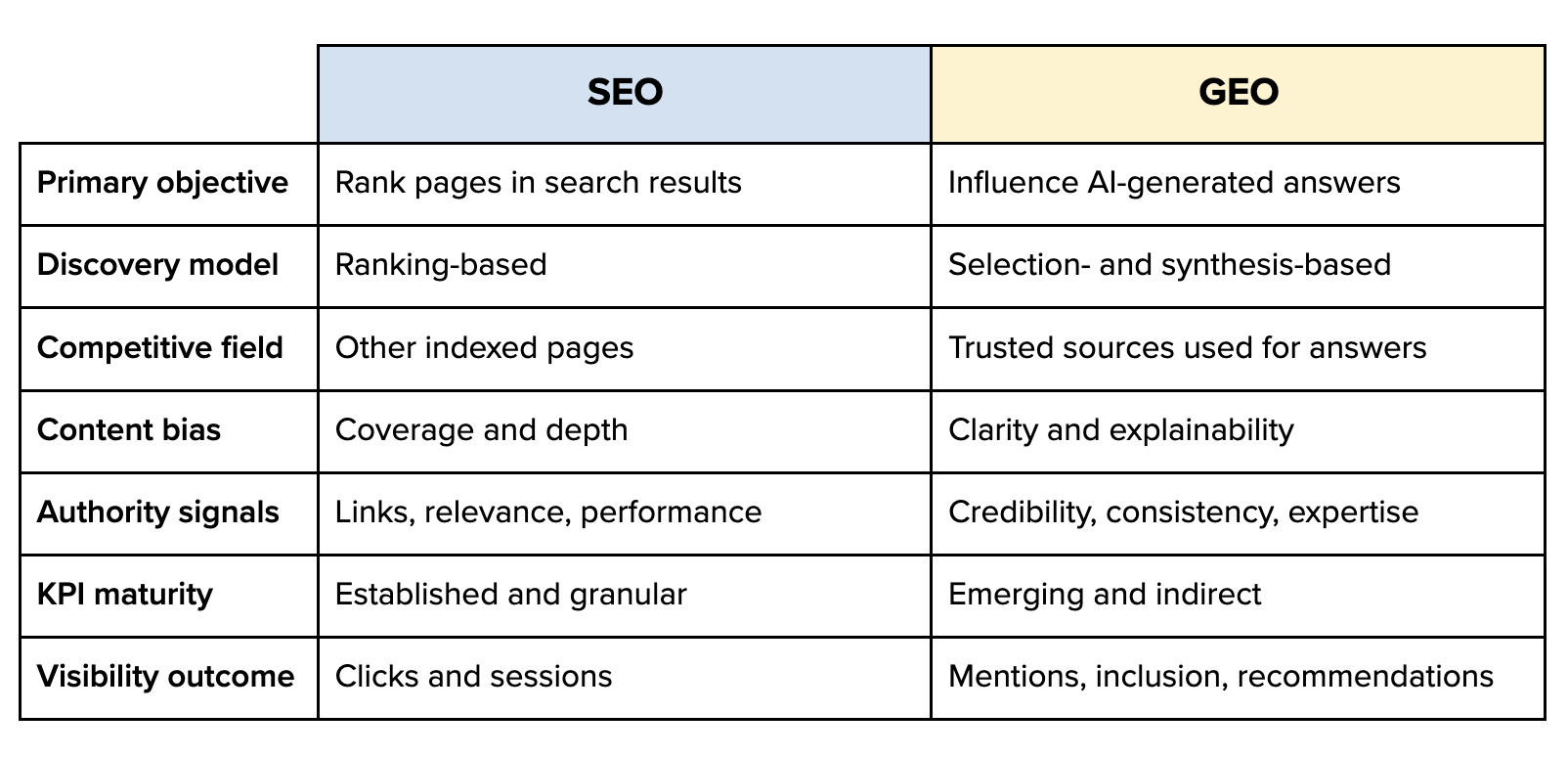
This is why GEO should not be treated as “SEO 2.0.” It is not a checklist layered onto existing practices. It represents a different mode of discovery that values explanation over placement and understanding over exposure.
The brands that adapt well are not abandoning SEO. They are expanding their definition of what visibility means.
Check out BCG’s article on the Future of Discoverability, and learn more about how SEO, AEO, and GEO are already converging.
How Content Needs to Evolve to Compete in Both
As discovery environments expand, the role of content is changing in subtle but important ways.
For years, content strategy emphasized coverage. Answer more questions. Target more keywords. Publish more pages. That approach still has value, particularly from an SEO perspective. On its own, however, it is no longer sufficient.
In generative environments, content is evaluated less as a standalone asset and more as a source of understanding (i.e., how clearly content communicates what it knows). Ideas that are well defined, logically structured, and grounded in expertise are easier for AI systems to interpret and reuse. Content that is vague or overly generalized is more likely to be ignored, regardless of how well it ranks. This is where the stigma and overreliance surrounding AI content intersect.
Low-quality automation erodes trust. Blind faith in AI-generated answers creates false confidence. The solution to neither problem is avoidance. It is intention.
Content that performs well across both SEO and GEO tends to share a few characteristics. It defines concepts clearly. It explains reasoning, not just conclusions. It reflects lived experience or informed perspective. It is structured in a way that supports skimming, extraction, and synthesis.
This is also where experienced content strategy and creation partners remain essential. Tools can accelerate production, but they cannot replace judgment, context, or the ability to shape ideas in a way that builds confidence.
As discovery becomes more mediated, expertise matters more, not less.
The Measurement Gap and Why it’s Normal
One of the most common concerns around GEO is measurement. Compared to SEO, where performance data is well established, AI-driven discovery can feel opaque.
Generative platforms do not yet offer consistent reporting on why a source was included, how often a brand is referenced, or what influenced a recommendation. Attribution is fragmented and often indirect.
At the same time, this does not mean GEO is unmeasurable. It just means it is earlier in its lifecycle.
Every major discovery channel has gone through a similar phase. Early SEO reporting was limited. Social media attribution took years to mature. Even today, some of the most valuable brand signals resist precise quantification.
For now, organizations evaluating GEO tend to look at directional indicators rather than definitive metrics. These include brand mentions in AI-generated responses, referral traffic from AI platforms, changes in branded search behavior, and qualitative feedback from prospects and customers.
These signals are imperfect, but they are meaningful. More importantly, they reward early understanding rather than delayed certainty.
Waiting for perfect measurement before adapting strategy has rarely been a winning move.
The Real Opportunity for Brands
It is tempting to frame AI-driven discovery as a threat. Fewer clicks. Less control. More uncertainty.
Generative search raises the bar for clarity, consistency, and credibility. As AI systems act as intermediaries between people and information, they must decide which sources to trust and which ideas to surface. That process favors brands that are intentional about how they explain what they do and why they matter.
This creates an opportunity.
Brands that invest in thoughtful content are no longer competing solely for rankings. They are shaping how discovery systems understand them. Over time, that understanding compounds, influencing whether a brand is included, referenced, or chosen.
Content, in this context, becomes long-term infrastructure. It establishes language, reinforces perspective, and builds trust across environments that may never resemble traditional search.
This opportunity does not belong exclusively to the largest or loudest brands. It rewards clarity over volume and coherence over noise. Organizations that know what they stand for, and articulate it well, are better positioned than those chasing every new platform or format.
Search Has Changed Before … This is the Next Chapter
Every meaningful shift in search has felt uncomfortable at first.
There was a time when publishing frequently was enough. Then authority mattered more. Then technical performance. Then intent. Each phase reshaped how content was created, evaluated, and valued. Each time, there were concerns that the old rules no longer applied.
History suggests something simpler. The rules did not disappear. They evolved.
AI-driven search does not invalidate SEO or content strategy. It changes where and how their value shows up. Visibility is no longer confined to a list of links. Trust is no longer inferred solely from rankings. Discovery increasingly happens through systems designed to summarize, recommend, and decide on a user’s behalf.
Brands that continue to invest in thoughtful content, clear positioning, and genuine expertise are not falling behind. They do need to recognize that being present is not the same as being included, and being indexed is not the same as being understood.
Search has not ended. It is simply asking more of the brands that want to be found.
When you’re ready to move beyond rankings and build content that earns trust in a changing search landscape, The Underground Group is here to partner with you.
FAQs
What is the difference between SEO and GEO?
Search Engine Optimization (SEO) focuses on helping content rank and get discovered in traditional search results. Generative Engine Optimization (GEO) focuses on helping content be selected, referenced, and synthesized within AI-generated answers.
SEO emphasizes discoverability, while GEO emphasizes interpretation and inclusion.
Is GEO replacing SEO?
No. GEO does not replace SEO. Strong SEO remains foundational for discoverability and indexing. GEO builds on that foundation by optimizing content for how AI systems interpret, summarize, and recommend information. The most effective strategies account for both.
Why doesn’t high search ranking guarantee visibility in AI search?
AI-driven search experiences often generate answers without presenting a list of links. Even highly ranked pages may be excluded if their content is unclear, difficult to synthesize, or lacks strong credibility signals. Visibility in AI search depends on trust, clarity, and explainability, not rankings alone.
What kind of content performs best for GEO?
Content that performs well in generative search environments is clear, well-structured, and grounded in expertise. It defines concepts explicitly, explains reasoning, and avoids vague or overly generalized language. AI systems favor content that is easy to interpret and confidently reference.
When should brands start thinking about GEO?
Now. Generative search is already shaping how users discover and evaluate information. Brands that begin adapting early gain a clearer understanding of how their content is interpreted and positioned, rather than reacting later once visibility has already shifted.
Do AI tools reduce the need for content strategy and expertise?
No. As discovery becomes more mediated by AI systems, content strategy and expertise become more important. While AI can assist with production and synthesis, it cannot replace judgment, context, or strategic clarity. Brands that invest in thoughtful content are better positioned to earn trust and visibility.